
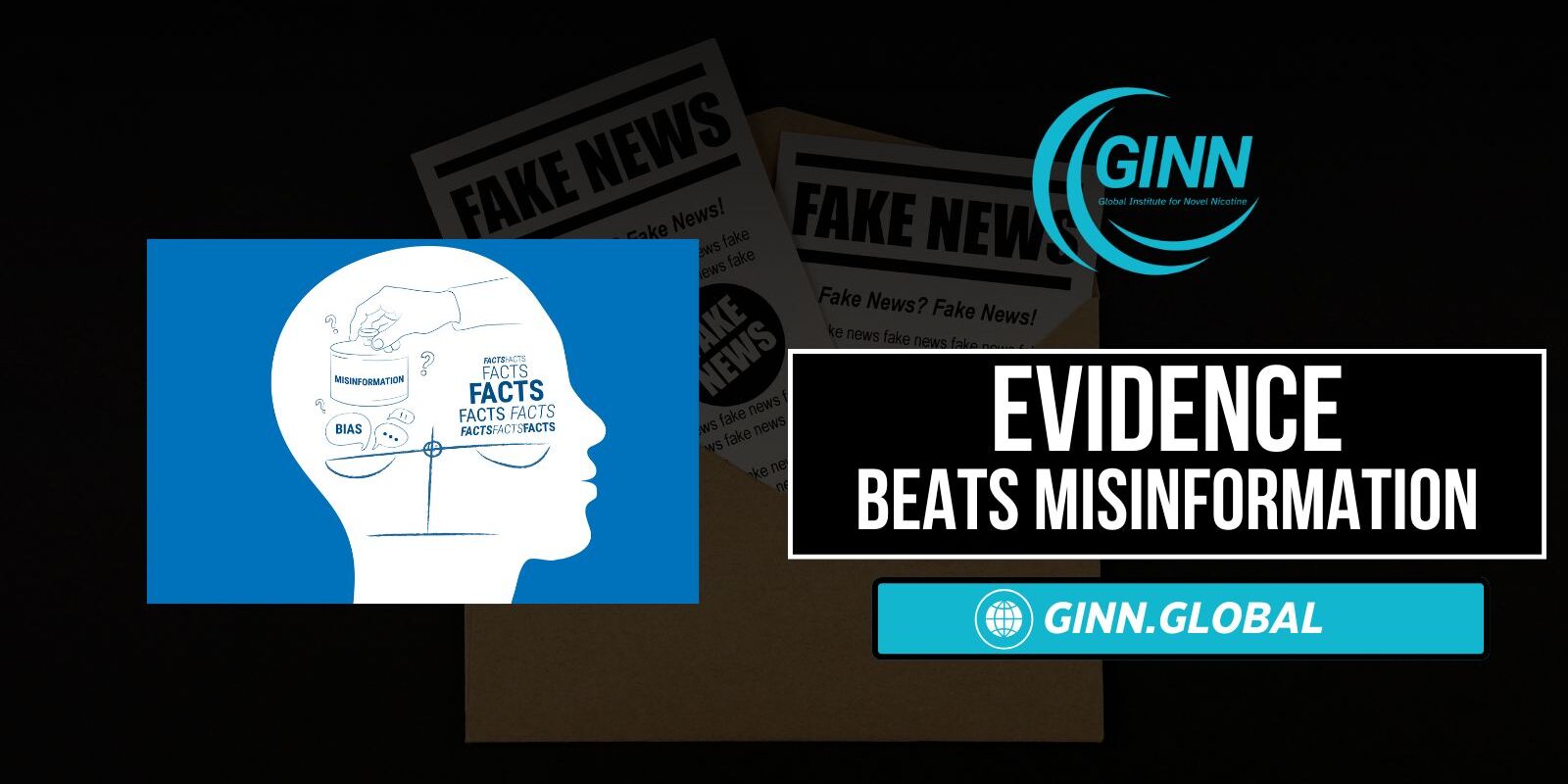
Public health policy depends on informed decision-making. Whether developing regulation, advising patients, or supporting smoking cessation, decisions are only as effective as the information on which they are based. When scientific evidence is misunderstood, selectively interpreted, or communicated without appropriate context, the consequences can extend beyond public debate and influence individual health behaviours.
This challenge has become increasingly visible in discussions surrounding smoke-free nicotine products, particularly electronic cigarettes. While scientific understanding continues to evolve, surveys conducted across multiple countries consistently suggest that a growing proportion of adults now believe vaping is as harmful as, or more harmful than, smoking combustible cigarettes. This trend raises important questions about how scientific evidence is communicated and how public perceptions influence smoking behaviour.
For policymakers, healthcare professionals, and regulators, the issue is not simply one of correcting misinformation. It is about ensuring that public health communication remains accurate, proportionate, and responsive to the evolving evidence base.
Public Perception and Scientific Evidence
Over the past decade, research into electronic cigarettes has expanded considerably. Numerous independent reviews have examined their toxicological profiles, patterns of use, and potential role in smoking cessation among adults.
While electronic cigarettes are not risk-free and should not be used by young people or non-smokers, many scientific and regulatory bodies distinguish between the risks associated with combustible cigarettes and those associated with non-combustible nicotine products. Combustion remains the principal source of the toxic chemicals responsible for smoking-related disease, whereas smoke-free nicotine products generally expose users to substantially fewer harmful constituents.
Despite this growing body of evidence, public understanding has often moved in the opposite direction. Surveys in several countries have reported increasing uncertainty about the relative risks of vaping compared with smoking, with many respondents believing that the two products present similar levels of harm.
This disconnect between scientific evidence and public perception presents a significant communication challenge.
Why Accurate Risk Communication Matters
Risk communication is not about promoting products. It is about ensuring that individuals receive information that accurately reflects the current state of scientific knowledge.
In public health, communicating relative risk is often essential. Similar approaches are used when discussing pharmaceuticals, alcohol consumption, food safety, infectious diseases, and environmental exposures. Communicating that one option carries lower risk than another does not imply that it is safe or recommended for everyone. Rather, it provides information that allows individuals and healthcare professionals to make better-informed decisions.
In the context of tobacco control, this distinction is particularly important for adults who continue to smoke despite repeated attempts to quit. If individuals incorrectly believe that all nicotine products carry the same level of risk, they may perceive little benefit in moving away from combustible cigarettes.
Accurate communication therefore supports informed choice without diminishing the importance of complete smoking cessation as the preferred outcome.
The Consequences of Misperception
Public misunderstanding can have practical implications for health behaviour.
Behavioural research consistently demonstrates that perceptions of risk influence consumer decisions. When relative risks are misunderstood, behavioural incentives may weaken. Adults who might otherwise consider switching from cigarettes to lower-risk alternatives may decide that such a change offers little benefit if they believe the risks are equivalent.
Healthcare professionals may also face greater challenges when discussing smoking cessation with patients if public messaging appears inconsistent or contradictory.
For regulators, this reinforces the importance of ensuring that public communication reflects evidence rather than assumptions or outdated perceptions.
Balancing Precaution and Accuracy
Public health authorities have an important responsibility to prevent youth nicotine initiation and discourage non-smokers from using nicotine products. These objectives remain fundamental components of tobacco control policy.
At the same time, precaution should not come at the expense of accuracy.
Communicating that smoke-free nicotine products are not risk-free is scientifically appropriate. Communicating or allowing the public to believe, that they present the same risks as combustible cigarettes is a different matter if the available evidence does not support that conclusion.
Evidence-based communication requires acknowledging both what is known and what remains uncertain.
This includes recognising that long-term research on some newer nicotine products continues to develop, while also accurately reflecting the substantial evidence already available regarding the health risks associated with smoking.
The Role of Healthcare Professionals
Healthcare professionals remain among the most trusted sources of health information. Their ability to communicate scientific evidence clearly and proportionately is therefore central to effective tobacco control.
Patients often seek guidance on smoking cessation, nicotine dependence, and the relative risks of different nicotine products. These conversations require nuanced communication that acknowledges uncertainty while avoiding unnecessary confusion.
Supporting clinicians with high-quality evidence, clear clinical guidance, and ongoing professional education can help ensure that patients receive balanced information grounded in current science.
Implications for Regulation
Risk communication is also a regulatory issue.
Policies governing product labelling, health warnings, public education campaigns, and marketing restrictions all contribute to how consumers understand relative risks. Regulatory frameworks should therefore be designed to communicate accurate information while maintaining strong safeguards for young people and non-users.
This approach aligns with broader principles of evidence-based policymaking, where regulatory decisions are informed by the totality of scientific evidence rather than isolated findings or public perceptions alone.
Looking Forward
Scientific knowledge will continue to evolve as new evidence emerges. Public health communication should evolve alongside it.
The objective is not to minimise the risks associated with nicotine use, nor to promote any particular product category. Rather, it is to ensure that public understanding reflects the best available evidence so that individuals, clinicians, and policymakers can make informed decisions.
Reducing smoking-related disease requires effective regulation, continued research, and clear communication. These objectives are complementary rather than competing.
For GINN, evidence-based policy depends not only on generating high-quality science but also on communicating that science accurately. In tobacco control, as in all areas of public health, misinformation, whether through exaggeration, omission, or misunderstanding, can itself become a barrier to better health outcomes.