
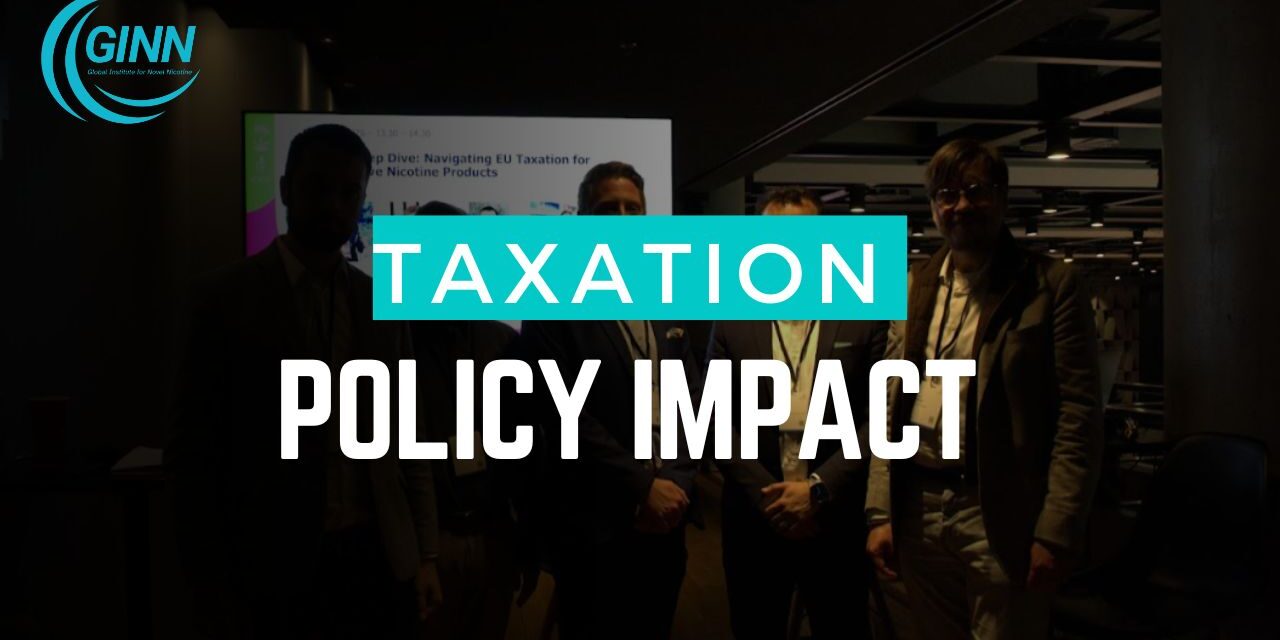
At EVO NXT 2026, the Global Institute for Novel Nicotine hosted a deep dive session examining how evolving EU taxation frameworks are shaping the regulation, availability, and market dynamics of alternative nicotine products.
The session was hosted by Joel Rubenstein and featured contributions from Johan Nissinen, Ciprian Boboi, Vlad Olteanu, and Tomasz Płaska, bringing together perspectives from policy, economics, and manufacturing.
The Role of EU Taxation Policy
The discussion focused on the revision of the EU Tobacco Taxation Directive (TTD), which aims to introduce greater harmonization of excise taxes across Member States. A central objective of the directive is to establish minimum tax levels, while allowing national governments to apply higher rates based on domestic priorities.
Speakers highlighted that taxation in this context serves multiple purposes, including generating public revenue, influencing consumer behavior, and shaping market conditions. However, the balance between these objectives remains a point of ongoing debate.
Complexity Across Product Categories
A key challenge identified during the session is the diversity of nicotine-containing products currently on the market. These range from combustible tobacco products to non-combustible alternatives, including vaping products, nicotine pouches, and pharmaceutical nicotine therapies.
This diversity raises questions about how taxation frameworks can differentiate between product categories in a way that is both consistent and proportionate.
Speakers noted that applying uniform tax approaches across fundamentally different products may not reflect variations in product characteristics, use patterns, or regulatory intent.
Harmonization and Market Impact
The need for harmonization across EU Member States was widely acknowledged. Currently, differing national tax regimes have led to cross-border purchasing and uneven market conditions, particularly where significant price differentials exist.
While harmonization may reduce these disparities, speakers emphasized that the level and structure of taxation will be critical. Excessively high tax rates, particularly when introduced abruptly, may lead to unintended consequences, including shifts in consumer behavior and changes in market dynamics.
Enforcement and Illicit Market Considerations
The session also addressed the relationship between taxation levels and illicit market activity. Evidence from certain jurisdictions suggests that when tax levels exceed certain thresholds, alternative supply channels may emerge, affecting both regulatory oversight and fiscal outcomes.
This highlights the importance of designing taxation frameworks that consider not only revenue objectives but also enforcement capacity and market responses.
Business and Compliance Implications
From an operational perspective, speakers outlined the increasing complexity facing companies operating within the EU. Compliance with taxation and regulatory requirements requires dedicated internal processes, including monitoring regulatory developments, managing product portfolios, and adapting to changing legal frameworks.
In some cases, these requirements may affect business models, particularly for smaller operators, who may face higher relative compliance costs.
The discussion also noted that taxation policy can influence market structure, including consolidation trends and shifts in manufacturing and distribution strategies.
Policy Direction and Ongoing Developments
Looking ahead, the session highlighted the interaction between taxation policy (TTD) and broader regulatory developments, including updates to the Tobacco Products Directive (TPD). These parallel processes are expected to shape both the legal status and fiscal treatment of alternative nicotine products across the EU.
Speakers emphasized the importance of considering these frameworks together, as taxation outcomes are closely linked to product classification, regulatory scope, and market access.
Conclusion
The GINN deep dive at EVO NXT 2026 underscored the complexity of EU taxation policy as it applies to alternative nicotine products. While harmonization remains a central objective, significant questions remain regarding implementation, proportionality, and market impact.
The discussion highlighted the need for continued engagement between policymakers, regulators, and stakeholders to ensure that taxation frameworks are predictable, enforceable, and aligned with broader public policy objectives.