
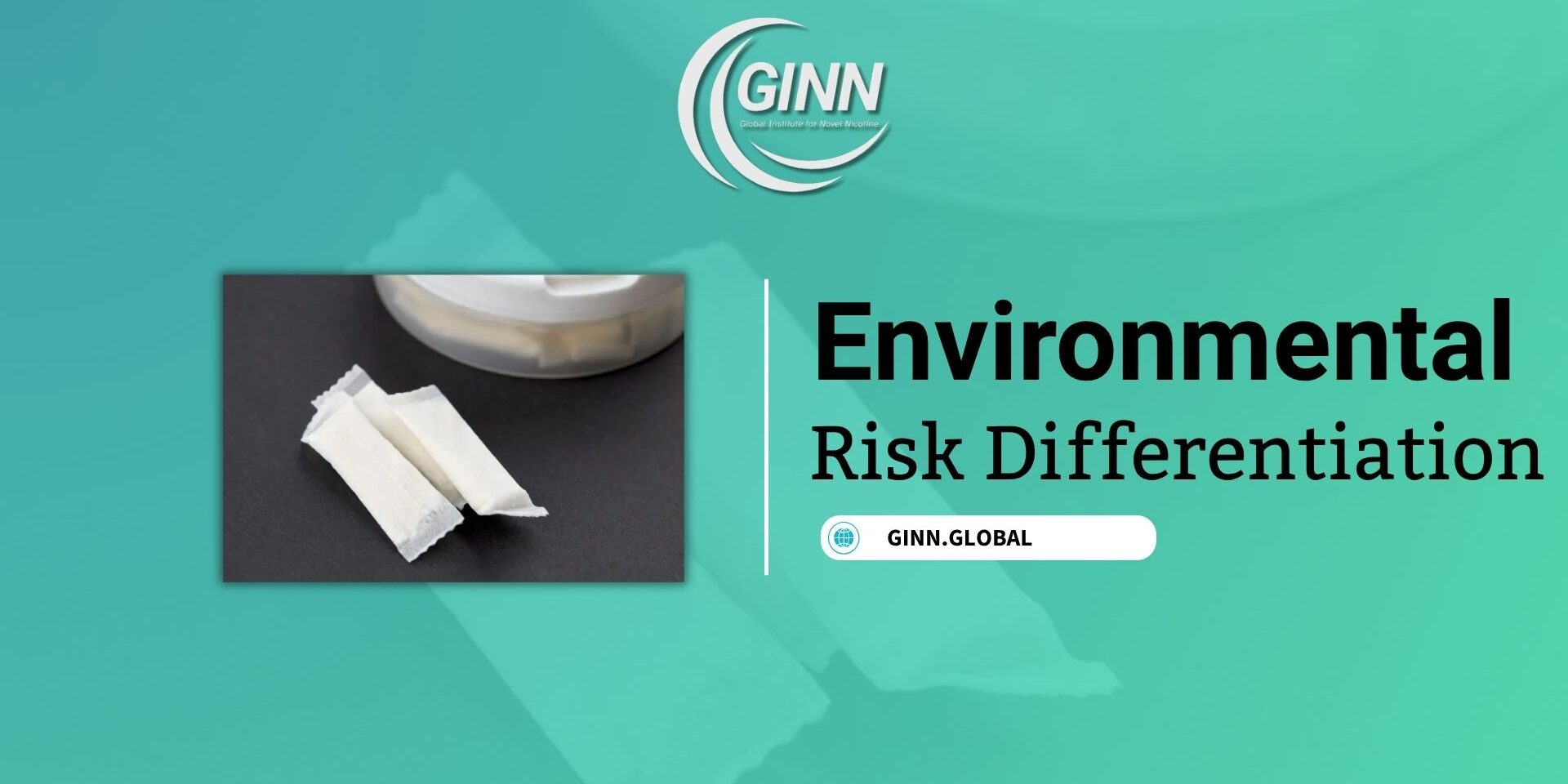
The U.S. Food and Drug Administration’s recent programmatic environmental assessment for nicotine pouch products may represent one of the more important yet underexamined developments in modern nicotine regulation.
While much public attention surrounding nicotine governance focuses on toxicology, youth access, and population health outcomes, the FDA’s latest findings introduce another increasingly relevant dimension into the conversation: environmental impact.
The assessment concludes that the marketing of certain nicotine pouch products submitted through the PMTA pathway is not expected to produce significant adverse environmental effects across air quality, water systems, land use, biological resources, or municipal waste streams under projected market conditions.
For regulators, policymakers, and public health stakeholders, this finding is significant because it reinforces a broader principle increasingly central to evidence-based nicotine governance: not all nicotine delivery systems create identical environmental externalities.
What the FDA Actually Evaluated
The environmental assessment was conducted by FDA’s Center for Tobacco Products as part of the PMTA review process for a family of nicotine pouch products manufactured by Helix Innovations LLC.
Under the National Environmental Policy Act (NEPA), FDA is required to evaluate whether authorizing a product may significantly affect the human environment. This includes examining manufacturing, use-phase behavior, and disposal impacts.
The assessment analyzed environmental considerations across several domains, including air and water emissions, hazardous waste generation, disposal pathways, litter potential, wildlife exposure, and broader municipal waste implications.
Across these areas, FDA concluded that authorizing the products would not result in significant environmental impacts.
Manufacturing Impacts and Industrial Integration
One of the assessment’s more important conclusions relates to manufacturing infrastructure.
FDA determined that production of the nicotine pouch products would not require major facility expansion, additional land-use modification, or significant new environmental permitting. The products are manufactured within an existing smokeless tobacco facility operating under established environmental control systems.
This is relevant because it demonstrates that introducing certain nicotine pouch categories may not necessarily create substantial new industrial burdens or require entirely new environmental infrastructure.
The assessment also identified no anticipated significant release of new pollutants or novel environmental contaminants beyond those already managed under existing operations.
Combustion-Free Use and Air Quality Implications
The use-phase findings are perhaps among the most differentiating aspects of the assessment.
Because nicotine pouches are smokeless and combustion-free, FDA concluded that they do not generate airborne combustion products or emissions during use.
This distinction matters within broader environmental and public health discussions.
Combustible cigarettes generate smoke, ash, cigarette butt waste, and combustion by-products that contribute to air pollution and environmental contamination. Many electronic nicotine products, meanwhile, raise separate concerns related to batteries, e-waste, metals, and cartridge disposal.
Nicotine pouches occupy a materially different profile. FDA noted that non-user exposure during use is expected to be minimal due to the absence of secondhand or thirdhand airborne emissions.
This does not eliminate all potential concerns, but it reinforces the importance of category-specific environmental assessment rather than generalized assumptions across all nicotine products.
Waste Streams, Disposal, and Environmental Exposure
The assessment also evaluated disposal and litter-related impacts.
FDA concluded that packaging associated with nicotine pouch products represents a very small fraction of overall municipal solid waste streams. The agency further determined that projected concentrations of nicotine and other constituents entering the environment through disposal remained below levels considered environmentally significant for aquatic toxicity.
The assessment additionally noted that certain pouch contents, including cellulose and sugars, are expected to biodegrade relatively rapidly.
At the same time, the document acknowledged that some pouch materials may persist environmentally if improperly discarded, contributing to broader concerns surrounding litter and microplastics. While projected toxicological impacts were considered limited at expected volumes, FDA’s findings reinforce that low environmental impact does not mean absence of responsibility.
Child Safety and Responsible Product Standards
Importantly, the FDA assessment does not frame nicotine pouches as environmentally consequence-free.
The document identifies accidental exposure risks, particularly involving children, if products are improperly stored or discarded.
This is a critical distinction for evidence-based governance.
The assessment supports neither unrestricted commercialization nor blanket prohibition. Instead, it points toward standards-based regulation focused on mitigation measures such as child-resistant packaging, disposal guidance, product stewardship, and consumer education.
This reflects a broader regulatory trend toward managing residual risks through targeted controls rather than assuming identical risk profiles across all nicotine categories.
Environmental Differentiation and Regulatory Proportionality
One of the broader implications of the assessment is its relevance to proportionality in nicotine regulation.
As governments increasingly evaluate environmental arguments within tobacco and nicotine policy, FDA’s findings suggest that combustion-free oral products may warrant differentiated environmental consideration relative to combustible products or some electronic systems.
This matters because environmental narratives around nicotine products have often been generalized across categories despite substantial differences in combustion, waste generation, emissions, and material composition.
The assessment reinforces a more evidence-responsive principle: regulatory frameworks may become more effective when they reflect measurable differences between product categories rather than treating all nicotine products as environmentally equivalent.
Environmental Policy and Public Health Policy Are Increasingly Connected
The FDA assessment also illustrates a broader convergence between environmental governance and public health governance.
Historically, environmental concerns surrounding tobacco centered largely on cigarette waste, smoke pollution, and more recently electronic waste from vaping devices. Nicotine pouch assessments introduce greater nuance by showing that environmental externalities may differ substantially depending on product format and exposure pathway.
This creates space for more calibrated policymaking.
Strict youth protections, product standards, responsible manufacturing, and evidence-based oversight can coexist with differentiated environmental evaluation. In this sense, environmental policy and public health policy need not operate in opposition.
Looking Ahead
FDA’s environmental assessment for nicotine pouches is not the final word on environmental impact, nor does it eliminate the need for continued monitoring, standards development, or product oversight.
What it does represent is an important regulatory milestone.
By formally evaluating environmental effects through a structured federal process, FDA has introduced a more granular framework for understanding how different nicotine categories interact with environmental systems.
For nicotine governance more broadly, the implications are substantial. Future regulation may increasingly depend not only on toxicology and epidemiology, but also on whether policymakers are willing to recognize meaningful differences in environmental externalities across product categories.
For evidence-based regulation, that distinction matters.